

Green hydrogen produced with renewable energy plays a key role in the green transition of many industries. The production costs of green hydrogen stem mainly from power supply and electrolysers, where the electricity system is a central factor. Reducing these costs helps lower the production costs of green hydrogen.
“Raising the voltage of the electrolysis system helps improve the investment and energy efficiency of hydrogen production. Industrial alkaline electrolysers usually operate at roughly a voltage of 200–400, but we aimed to raise the voltage to improve cost efficiency. We reached 1,000 volts in our laboratory by connecting stacks in series. As far as we know, it's a world record,” says Jero Ahola, professor of energy efficiency at LUT.
Investment costs in the entire system decrease
If the voltage of the electrolyser is raised, it reduces the need for current to achieve the same capacity. This decreases losses and the costs of electricity supply and power electronics.
“Electricity supply and power electronics compose about one fourth of the costs of a hydrogen production plant. If this share could be cut in, say, half by raising and lowering the current, the investment cost of the entire system could decrease by roughly 10–15 per cent,” Ahola says.
LUT’s research focuses especially on the investment costs and flexibility of the system, because the intermittency of renewable electricity decreases the annual operating hours of the equipment and therefore highlights the importance of capital costs.
Video about LUT University's alkaline water electrolyser system. If it's not visible to you, you can also watch it on YouTube.
Challenging serial connection
The record-breaking voltage was achieved by using ABB's power electronics and stacks of the Estonia-based electrolyser manufacturer Stargate Hydrogen. The research is co-funded by ABB.
The voltage of a single electrolytic cell is approximately 2, so 1,000 volts is achieved through the serial connection of nearly 500 cells. However, it is technically challenging, because the conductive electrolyte that circulates between the cells causes stray currents, leading electricity to the wrong places and causing additional losses. Various technical solutions can help decrease those currents.
“Our research shows that a series-connected alkaline electrolysis system can operate at 1,000 volts using modern power electronics found in wind and solar power plants as well as battery systems,” Ahola sums up.
The reduction in hydrogen production costs depends more specifically on where the plant is operated and whether it is run continuously or according to the availability of wind and solar power. With renewable electricity, there are fewer operating hours, which increases the impact of the investment cost per unit of hydrogen produced.
Further research focuses on optimising and minimising stray currents
Next, the researchers aim to develop methods to design series-connected systems that are as techno-economically efficient as possible. This includes digital modelling, simulation, and optimisation to transfer lessons learned in the laboratory to larger-scale systems. In addition, further research will focus on minimising stray currents in the electrolyte without significantly reducing system performance.
A peer-reviewed scientific article on the 1,000-volt system has not yet been published, but several articles about earlier stages of the research have been published over the past three years. Moreover, the topic has been examined in several doctoral dissertations.


More information:
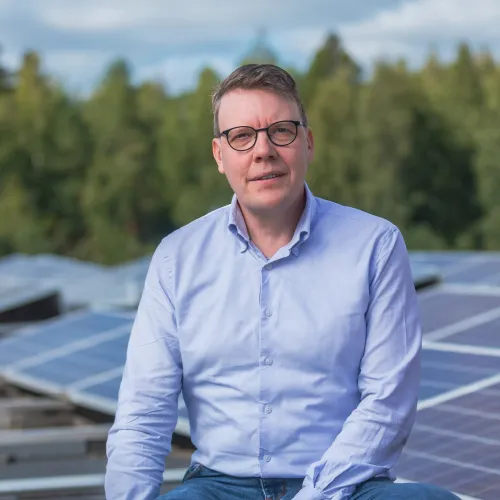

Vesa Ruuskanen

Markku Niemelä
Read next:


The Curious People newsletter shares our solutions for helping build resilient communities, industry, and businesses while promoting the energy transition and the regenerative use of natural resources.