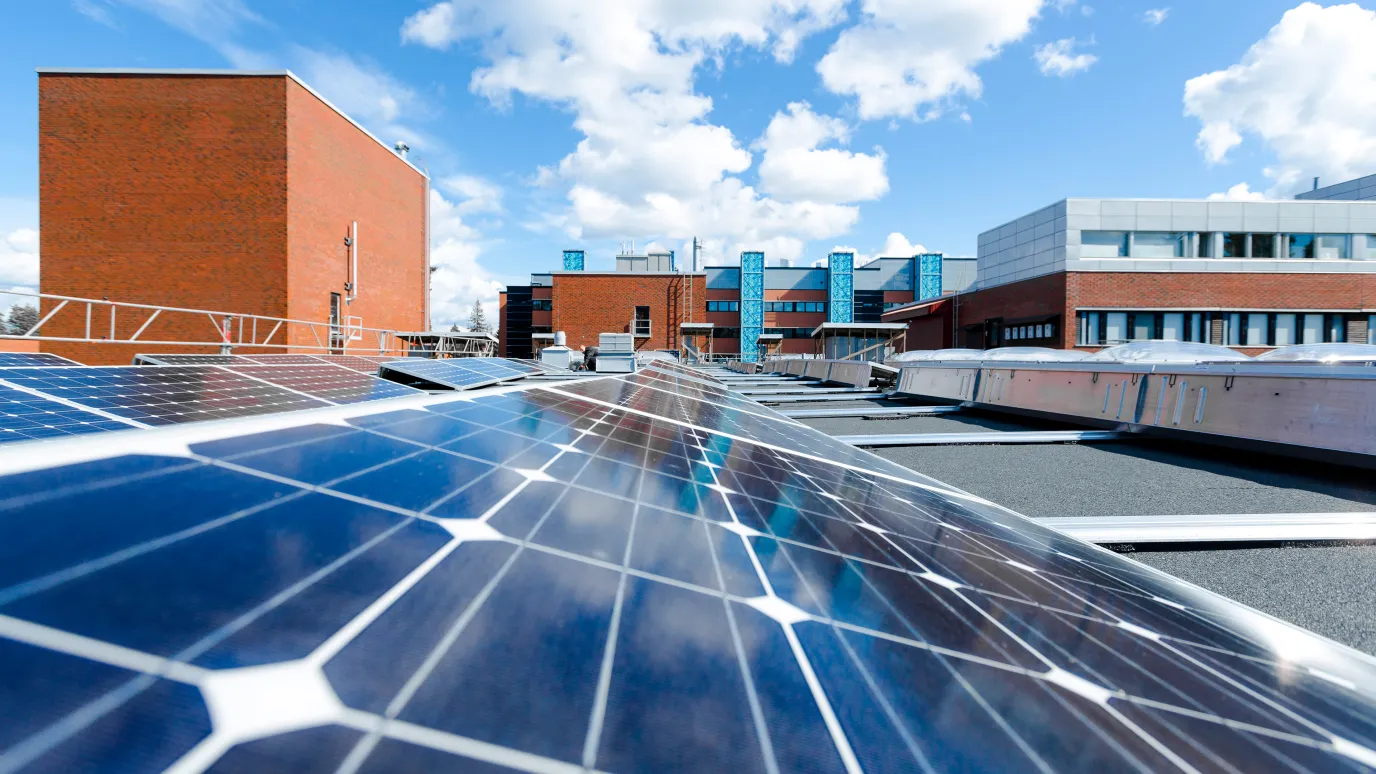

It is increasingly important to enable the production of fuels and core chemicals. such as methanol and ammonia, without reliance on fossil resources. Hydrogen produced via electrolysis of water using renewable electricity serves as a clean feedstock that directly replaces fossil-derived hydrogen in these industrial processes. The case for on-site renewable hydrogen production is further strengthened by the growing energy challenges facing large industrial sites and data centres: grid constraints and high grid reinforcement costs are making on-site electricity generation increasingly attractive, and coupling it with hydrogen production creates a pathway to both decarbonise industrial feedstocks and improve energy security simultaneously.
Solar and wind power are typically the most cost-effective and scalable options for on-site electricity generation and hydrogen production. However, their output is inherently variable — and rather than treating this solely as a problem to be solved through energy storage, it can be addressed through demand-side flexibility. Research at LUT University has shown that hydrogen consumers capable of adapting their consumption patterns can procure hydrogen at a lower cost than those requiring a constant supply. Bridging the mismatch between variable generation and industrial demand therefore calls for not only energy storage, but above all smart system design that leverages flexibility across the entire value chain.
Achieving cost-effective hydrogen production solutions requires careful optimisation across system, component, and operational levels to ensure correct dimensioning and balance capital and operating costs. In systems with high shares of variable renewables, some degree of electricity curtailment is an accepted and often economically rational outcome: since renewable electricity is low-cost by nature, the objective is not to capture every available watt, but to find the most economical overall system configuration. Oversizing storage or electrolyser capacity to eliminate all curtailment would itself introduce unnecessary costs that outweigh any efficiency gain.
This challenge is at the core of the OffgridH₂ project at LUT University, which investigates how renewable electricity can be converted into hydrogen in a cost-efficient manner through advanced system architectures, component-level optimisation, and dynamic control strategies. In the context of this research, “off-grid” is used as a modelling abstraction rather than a description of real-world infrastructure.
This abstraction enables a clearer understanding of system behaviour under renewable-only operating conditions by isolating the effects of variability and flexibility. While most real hydrogen systems remain grid-connected, the off-grid approach provides valuable insights into system design, operational strategies, and cost optimisation that are directly applicable to also grid-integrated solutions relying mainly on renewable energy.
What has the research revealed so far?
Project Manager, Dr. Pietari Puranen from LUT University explains: “Our results indicate that low-cost renewable hydrogen can be produced from local energy sources. The primary trade-off lies between energy storage and system flexibility: greater flexibility in system components reduces the need for storage investment. This relationship applies both to the operation of the electrolyzer relative to electricity storage and to hydrogen demand-side flexibility relative to hydrogen storage. Although water electrolyzer flexibility remains constrained by safety requirements and degradation, our findings suggest that these limits can be expanded through improved system control. This implies that, by adapting control strategies and design practices—traditionally based on constant electricity supply—electrolyzers can be made to operate safely and efficiently also under variable power conditions.”
Visit also the project webpage