
LUT Blossom is a growth event, during which our Lahti campus will become an arena for fresh ideas, networking, and new partnerships.
Lahti is LUT University's second and newest campus city. In just a short time, LUT's impact on both migration to the city and the city’s economy has been enormous.
For example, the number of students at LUT in Lahti has grown at an annual rate of 200. The growth has also been reflected in the population: last year, Lahti was the sixth most growing city in Finland. The last time the city was in a similar situation was in the 1970s.
“Together with LAB University of Applied Sciences, LUT is one of the factors that enlivens the city the most. Higher education institutions are a big part of Lahti both operationally and financially. Through LUT's growth, RDI activities in the Päijät-Häme area have grown tremendously in recent years,” says Niko Kyynäräinen, the mayor of Lahti.
Despite its short history as a university city, Lahti has developed strong regional cooperation.
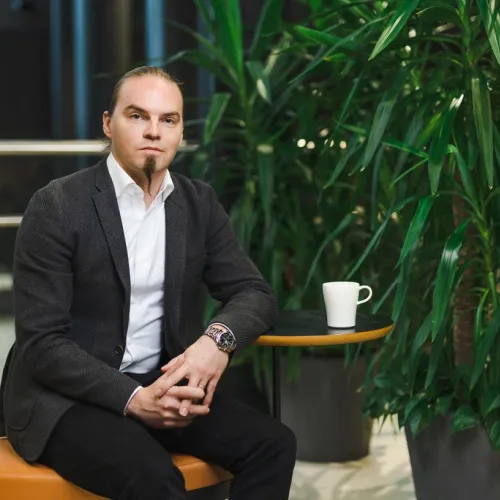
“Lahti does not have a long university tradition behind it. Tradition brings strength to operations, but we have turned the lack of it into an advantage. We are building collaboration between the university and the region in a new, open-minded way,” says Chief Gowth Officer Petri Ajo.
Ajo describes Lahti as a sandbox where it is always possible to try new initiatives. This supports the fact that cooperation with LUT can be much more than theses, summer employees and supervised internships. The research centers and laboratories established in cooperation with companies are just a few examples.
left
Partnerships support both LUT's research and Lahti's business life
In Lahti, the collaboration between the business community, the region and the university is close-knit. This can be seen, for example, in the Electric Mobility Research Center (EMRC), which was established as a joint project between LUT and Kempower, and in the fiber technology laboratories created in cooperation with ANDRITZ. A total of 20 companies are located on LUT's Lahti campus.
“LUT and LAB are a clear attraction factor for companies. For instance, the presence of Finland’s largest higher education institution in the software field shows in the location and growth of companies in the city,” Kyynäräinen says.
He also highlights the news published by Fazer last summer. The company announced that it would invest 400 million euros to build a new chocolate factory in Lahti.
Kyynäräinen says that both LUT and LAB bring strong food industry and green transition expertise to the city. These were significant advantages in favor of Lahti as a location. This expertise takes a concrete form, for example, in LAB's Food Pilot Plant, which collaborates in RDI with the Päijät-Häme grain cluster.
“And I also must mention the LAB Institute of Design which engages in significant cooperation with Luhta, a Lahti-based Finnish sportswear brand. Luhta is one of the world's largest sports brands that continues to grow.”
Ajo says that the university's partners will showcase their cooperation with LUT at LUT Blossom growth event this spring on the Lahti campus. Blossom will gather together business influencers, leading scientists, and decision-makers. The event is open for businesses of all sizes.
“In addition to showing the participants of the event what cooperation can be and what it has brought to our partners, we hope that the participants will come up with new ideas that could work in their company,” Ajo says.
right


If we can maintain the level of cooperation, Lahti can grow into a top European university city.
Collaboration with Lahti is going exceptionally well
The city itself also engages in research with LUT. For decades, Lahti has carried out long-term and ambitious environmental work by restoring Lake Vesijärvi, for example. In 2021, the city was nominated as the European Green Capital, but the environmental work did not end there.
“The research collaboration culminates in the environmental perspective and the green transition. For example, LUT has calculated the nature footprint of Lahti, and the Lahti campus has a joint professorship in atmospheric science between LUT and the University of Helsinki,” Kyynäräinen says.
Petri Ajo praises all collaboration with Lahti as very smooth. All partners are committed to cooperation, and the working culture is collegial.
“We are colleagues rather than partners. The city also takes our bold initiatives into consideration, and this is in turn reflected in growth and development. If we can maintain this level of cooperation, I would see that Lahti can grow into a top European university city.”
left
LUT and Lahti before, now and in the future
- 1996 – LUT's Lahti unit begins its operations.
- 2019 – LUT's Lahti unit expands into a campus.
- 2025 – The Lahti campus brings together approximately 2,000 LUT students, more than 6,000 LAB students, 800 university employees and 20 companies.
- 2026 – LUT Business School expands to Lahti.
- 2027 – LUT's Civil and Construction Engineering program begins in Lahti.
- 2035 – The goal is to increase the number of students on the Lahti campus to 20,000.
right
Growth is only limited by imagination – if even that
LUT's growth in Lahti has been surprisingly fast, and it won’t be slowing down in the coming years either. The goal is to increase both the number of students and the scope of regional business cooperation.
To support growth, LUT, LAB and the city of Lahti are now investigating the establishment of a new campus in Ranta-Kartano near the city center. The location would bring students to enliven the city center and also act as an engine for new business activities.
“Of all Finnish universities, LUT receives the most funding from the business sector. We expect that new companies will emerge in the area in LUT's wake, and that existing companies will find opportunities for growth in the cooperation,” Kyynäräinen says.
Ajo does not want to paint any specific visions for the future. It is not because of lacking imagination, but rather the opposite. In Lahti, the limits of growth have not yet been reached.
“Although we are growing in Lahti in line with our strategy, it is important that we do not yet know exactly what the future holds. There are so many things happening at LUT right now that in the near future, it will become a virtuous circle. Our job is to take advantage of the pieces around us and find the pieces that are missing.”


More information: