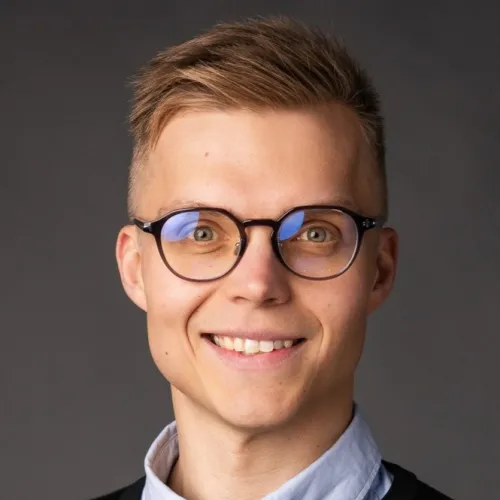

Who are you and how have you ended up in your current role?
I’m an LUT University alumnus and have built my academic career here in mechanical engineering. I've been researching the behaviour of steel structures – particularly welded joints – under demanding loading conditions for over a decade. My recent tenure track appointment as an assistant professor of steel structures is a natural continuation of this long-standing work. As the leader of a ten-person research group, I can advance research themes that I've been pursuing throughout my career.
What research are you conducting and why is it important?
I specialise in ultra-high-strength steels – a research field where LUT is recognised internationally as a pioneer. I look at the big picture: how material properties, geometry, manufacturing processes, and loading conditions all influence the strength and reliability of steel. My main research focus is fatigue, but I also study other failure mechanisms.
It’s important to understand that a structure’s mechanical behaviour often results from the combined effects of the factors above. When you understand the full picture, you can develop lighter, safer, and more durable structures, which are especially critical for heavy industry, transportation, and energy technology.
How do you see the future of the field and your research?
Three key development directions are fossil-free steel production, digital modelling, and multi-material structures and hybrid manufacturing. The field is evolving rapidly and challenges researchers to respond to both scientific questions and growing industry needs.
Steel production currently accounts for about 7% of global carbon dioxide emissions. Researchers have a huge opportunity to reduce the heavy industry’s carbon footprint. Key research areas include new steel grades and their performance and greener steel structures.
Digital modelling processes and tools have advanced a great deal in a short time. Simulation methods and the digital twins built around them are becoming an increasingly important part of both research and industrial product development processes.
Sustainable industry needs lightweight structures, the best possible performance, and efficient processes. One development trend is combining traditional manufacturing methods with multi-material solutions and hybrid manufacturing that incorporate additive manufacturing – also called 3D printing. Digital modelling is an important tool in developing new structural solutions.
What inspires you in your work?
Getting a deep understanding of steels and structures in their real-world environment. It’s rewarding to see how fundamental research creates new understanding and solutions that transition into applied research and then into applications that impact real structures and industrial practices.
Constant renewal also fascinates me. I get to work daily with new phenomena, technologies, and questions and contribute to the future development of materials, manufacturing solutions, and structures.
Tell us something about yourself that others may not know.
I’m an avid cyclist. All that exercise works up an appetite, so you’ll easily find me in a chef’s apron at home whenever anyone needs something savoury or sweet.
More information: