

Climate change and biodiversity loss are interlinked challenges that must be addressed simultaneously.
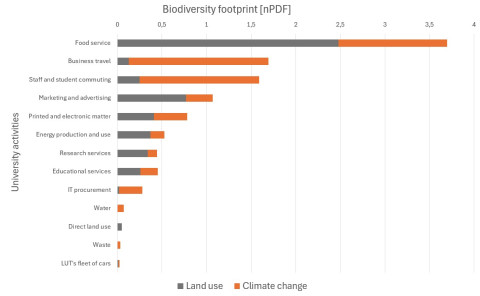
LUT’s biodiversity footprint in terms of global species loss was first assessed in 2025. The assessment was carried out as a master’s thesis based on operational data from 2024. The study partly drew on the same data as LUT’s carbon footprint assessment but employed additional sources such as the Ecoinvent and EXIOBASE databases especially for land use. The calculation covered impacts on species in terrestrial and freshwater ecosystems, whereas impacts on marine ecosystems were excluded.
Campus food services accounted for 23 per cent of LUT’s biodiversity footprint in terrestrial ecosystems and 13 per cent in freshwater ecosystems. Coffee consumption stood out as a notable example of contributing factors.
Assessing the university’s biodiversity footprint raises many questions regarding the availability, applicability, and accuracy of data sources. Assessment methods continue to develop, and the assessment will be refined to provide a more robust outcome. In general, it seems clear that our efforts to reduce LUT’s carbon footprint have also largely benefited biodiversity.
We focus on environmental handprint
In addition to the carbon footprint and biodiversity footprint, we also pay attention to LUT's environmental handprint.


