

left
We build computational models of mechanical systems — starting from multibody dynamics and hydraulics — and extend them with data-driven methods for real-time use. Our robotic systems target tough environments: construction sites, forests, waterways, and heavy industry. Physical experiments validate every model. Current work includes real-time fatigue monitoring for mobile machinery, climbing robots for construction, biomimetic underwater robotics, and automated heavy-duty EV charging.
right
Group leader
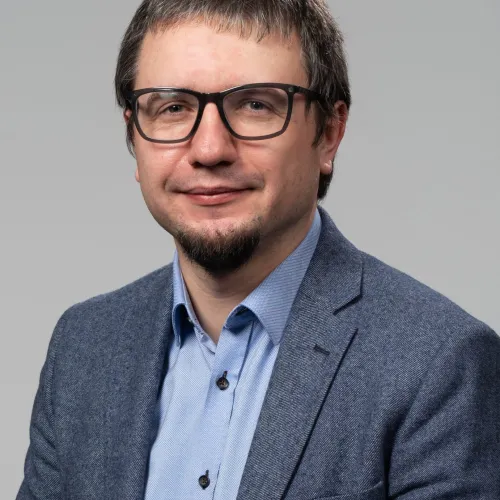
Grzegorz Orzechowski
Associate Professor (Tenure Track)
Mechanical Engineering
left
Research areas
- Digital Twins for Machinery — Operational digital twins for non-road mobile machinery, from design through real-time monitoring. Emphasis on physics-based fidelity, virtual fatigue assessment, and lifecycle relevance.
- Multibody Dynamics and Computational Mechanics — Flexible multibody formulations, hydraulic system modeling, real-time simulation, and foundational methods research. The computational backbone of the lab.
- Data-Driven and Physics-Informed AI — Surrogate models, deep learning for mechanical systems, and reinforcement learning for control. Always grounded in physical structure.
- Robotics for Demanding Environments — Sim-to-real transfer and custom robotic platforms for construction, forestry, underwater, and heavy equipment applications. Mechanics-first autonomy.
- Human–Machine Interaction and Human Digital Twins — Modeling human motion, safety, and interaction within machine workspaces.
- Virtual Sensing and Real-Time Estimation — State estimation, surrogate-based virtual sensors, and real-time fatigue monitoring for systems where direct measurement is impractical.
left
Infrastructure
- Computation — High-performance computing for simulation, surrogate training, and reinforcement learning.
- Simulation platforms — Digital twin and real-time simulation environments, including Exudyn, NVIDIA Omniverse, and Simscape.
- Experimental systems — Robotic platforms and mechanical test setups for validation and sim-to-real transfer.
- Sensing and motion capture — Sensor systems and tracking for experimental validation, virtual sensing research, and human–machine interaction studies.
Projects
VIIMA
Real-time virtual fatigue monitoring for lightweight structures in mobile machinery. With Konecranes, Ponsse, Sandvik, and University of Oulu.
Construction Robotics
Custom-designed legged climbing robot for scaffolding and construction site automation.
Biomimetic Water Robotics
Bio-inspired robotic systems for underwater operations.
Heavy-Duty Charging Automation
Automated charging solutions for electric heavy-duty vehicles.
Foundational Methods in Multibody Dynamics
Advancing formulations for flexible multibody simulation, including projective geometric algebra approaches.
Publications
Group members